Why Nylon is Still the Preferred Material for SPM Hawsers
| Property | Nylon | HMPE | Polyester |
|---|---|---|---|
| Energy Absorption | ⭐⭐⭐⭐⭐ | ⭐⭐ | ⭐⭐⭐ |
| Shock Load | Excellent | Moderate | Good |
| Fatigue | Excellent | Good | Excellent |
| Floating | No | Yes | No |
| Offshore Hawser | ⭐⭐⭐⭐⭐ | Limited | Limited |
Unlike general mooring ropes, SPM hawsers experience continuous dynamic loading from tanker motions. Nylon’s superior elasticity and energy absorption make it the preferred choice for OCIMF-recommended offshore mooring applications.
Designed for Offshore Loading Operations
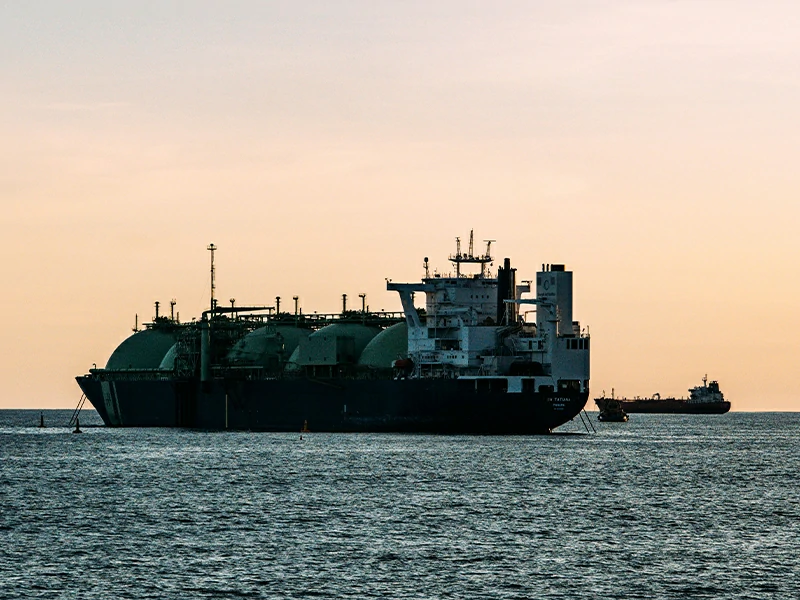
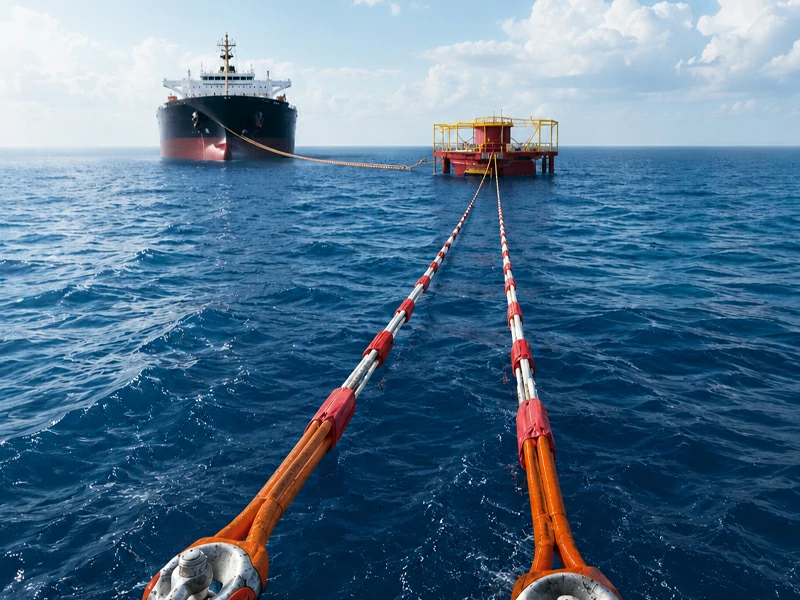
CALM Buoy Systems
Reliable mooring solutions for offshore crude oil loading, allowing tankers to safely weather-vane under changing wind, wave, and current conditions.
SALM Systems
Designed for Single Anchor Leg Mooring applications where deep-water operations and compact offshore loading systems are required.
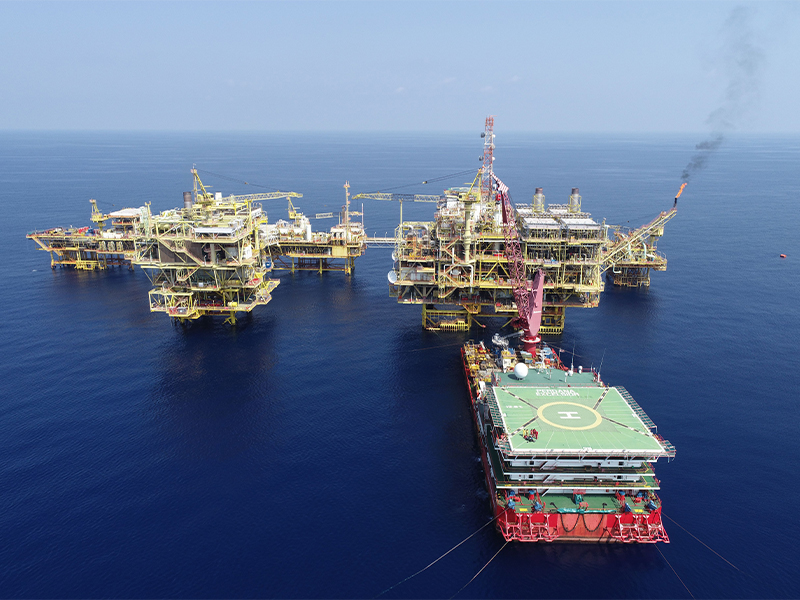
FSO/FPSO Offloading
Secure mooring hawsers for floating production and storage units, ensuring safe cargo transfer in demanding offshore environments.
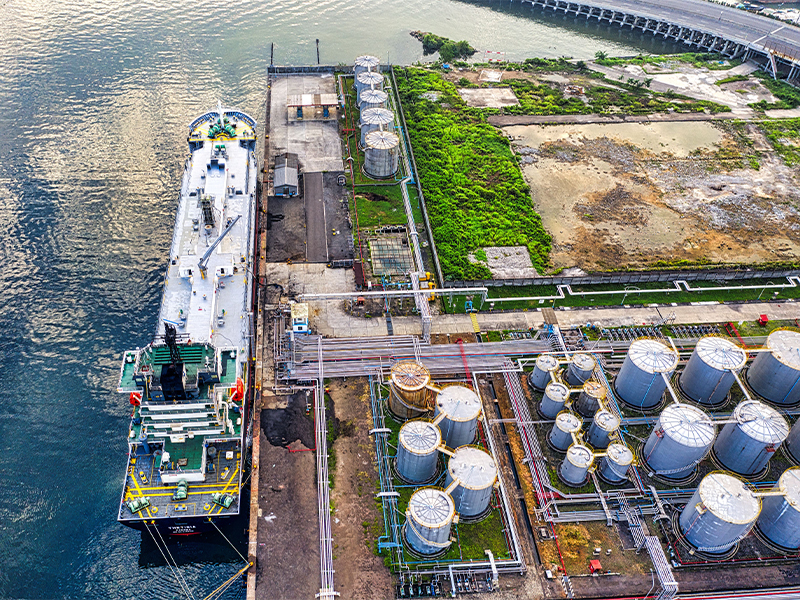
Offshore Oil Terminals
Engineered nylon hawsers for offshore terminals, supporting safe tanker mooring and continuous oil transfer operations.
How an SPM Hawser Works
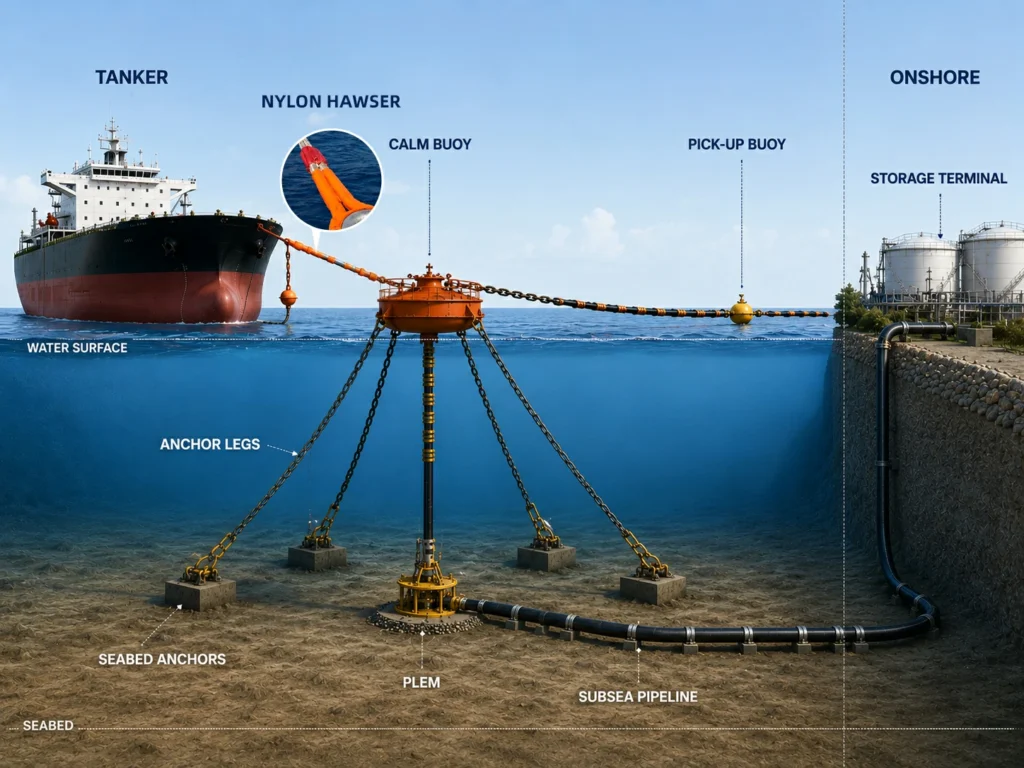
Tanker
The tanker approaches the CALM buoy and connects to both the mooring hawser and the floating hose. Once secured, it can safely weather-vane around the buoy
Pick-up Rope
The tanker approaches the CALM buoy and connects to both the mooring hawser and the floating hose. Once secured, it can safely weather-vane around the buoy while maintaining a stable position during cargo transfer.
Nylon SPM Hawser
The nylon hawser is the primary mooring line between the tanker and the CALM buoy. Its excellent elasticity absorbs dynamic loads generated by wind, waves, and vessel motions, helping protect both the buoy system and the tanker.
Chafe Chain
Installed between the hawser and the buoy, the chafe chain protects the rope from concentrated abrasion and wear at the connection point, significantly extending the service life of the hawser.
CALM Buoy
The CALM (Catenary Anchor Leg Mooring) buoy acts as the central mooring structure. It allows the tanker to rotate freely with changing environmental conditions while providing a stable platform for offshore oil transfer.
Anchor Legs
Multiple anchor legs transfer mooring loads from the buoy to seabed anchors, ensuring the buoy remains securely positioned under varying sea states and operating conditions.
PLEM
The Pipeline End Manifold (PLEM) is installed on the seabed directly beneath the CALM buoy. It connects the subsea pipeline to the flexible riser hose and serves as the transition point between offshore pipeline infrastructure and the floating transfer system.
Floating Hose
The floating hose transports crude oil from the CALM buoy to the tanker manifold. Designed for continuous offshore service, it accommodates vessel movement while maintaining safe and efficient product transfer.
Subsea Pipeline
The subsea pipeline carries crude oil between the offshore loading system and the onshore storage terminal. Buried or laid along the seabed, it provides a reliable transportation route under harsh marine environments.
Storage Terminal
After passing through the subsea pipeline, crude oil is delivered to the onshore storage terminal for temporary storage, processing, or distribution before further transportation.
The nylon SPM hawser is one of the most critical safety components in the entire offshore mooring system. Its ability to absorb dynamic loads while maintaining reliable mooring performance directly influences operational safety, equipment longevity, and terminal efficiency.
How to Select the Right SPM Hawser

Why Offshore Operators Choose Our Nylon SPM Hawsers
High Energy Absorption
Reduces peak loads generated by vessel motions.
Excellent Fatigue Resistance
Designed for long-term cyclic loading.
Superior Abrasion Resistance
Suitable for severe offshore environments.
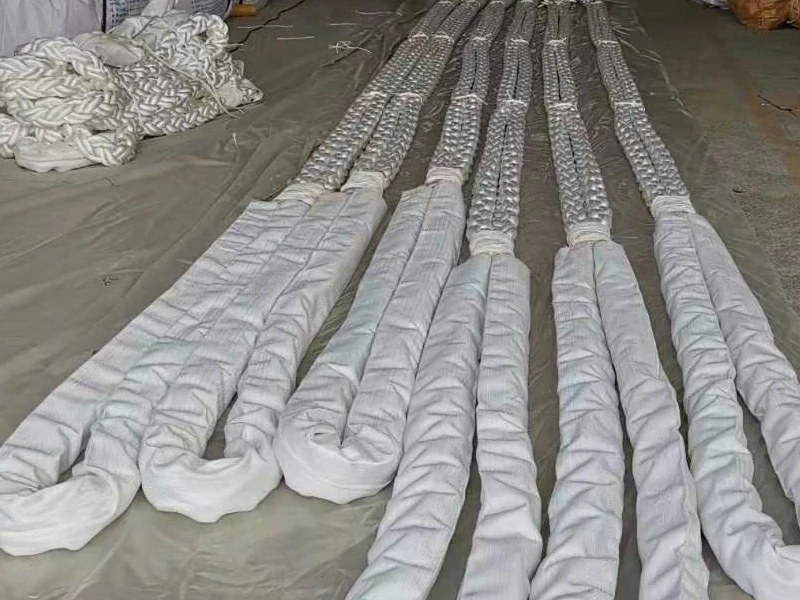
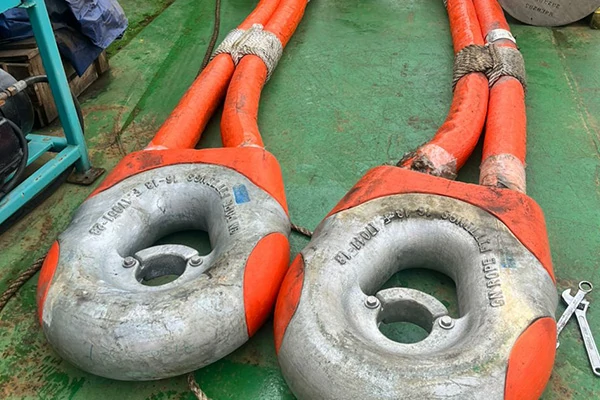
Protected Eye Splices
Reduced wear in critical load zones.
Not sure which rope fits your project?
We help you select based on:
- Vessel type (tugboat, tanker, bulk carrier)
- Required breaking strength (MBL)
- Working conditions (port, offshore, towing)
KEY SPECIFICATIONS
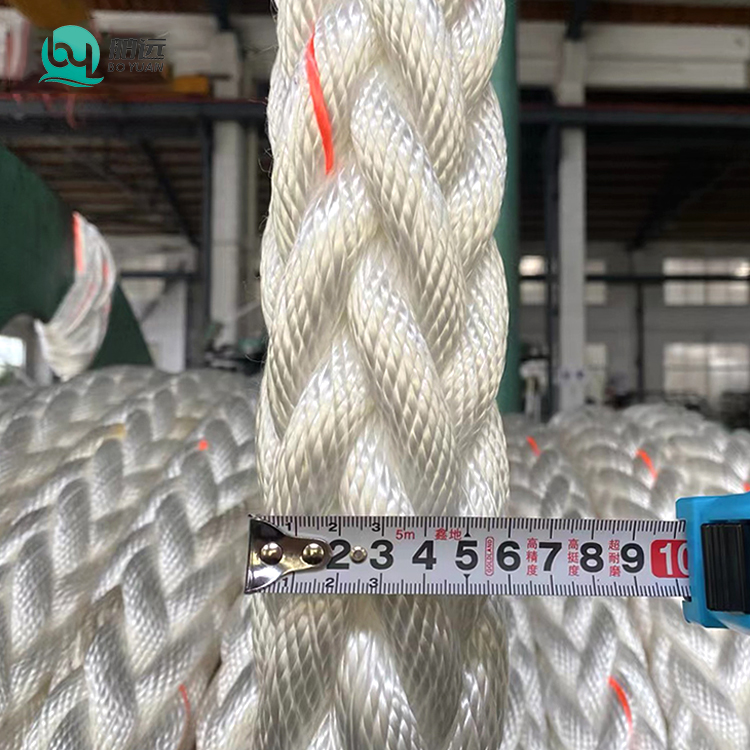
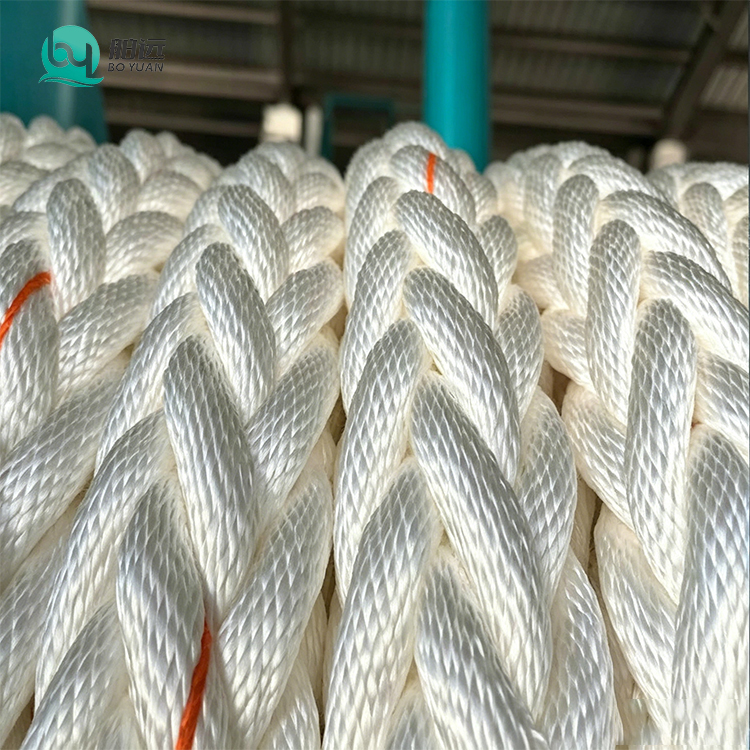
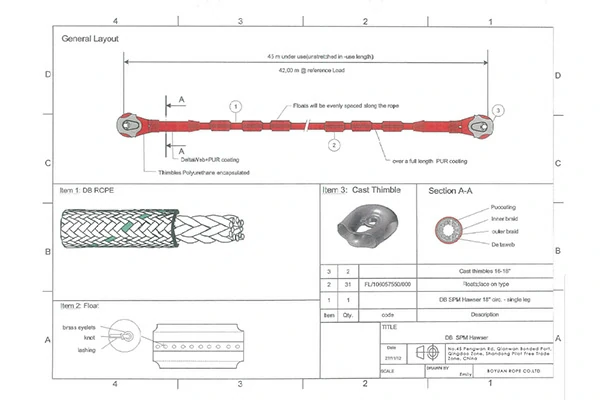
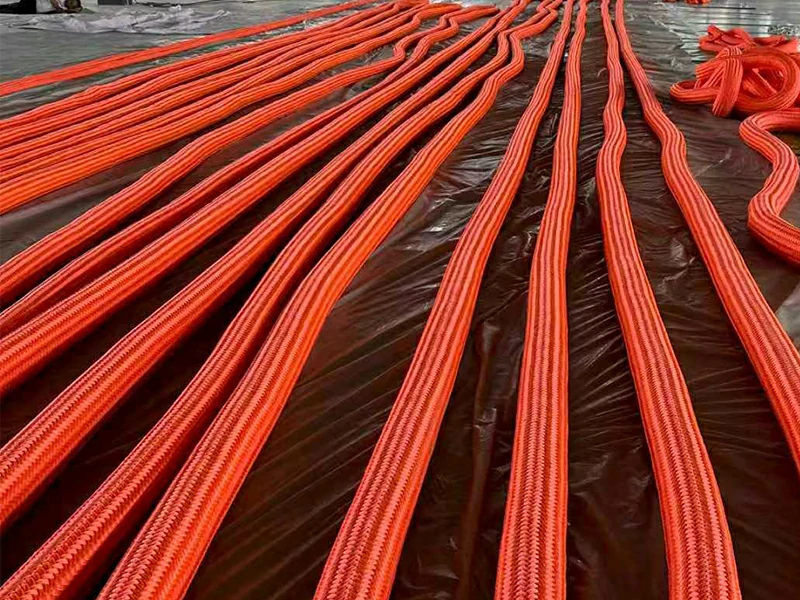
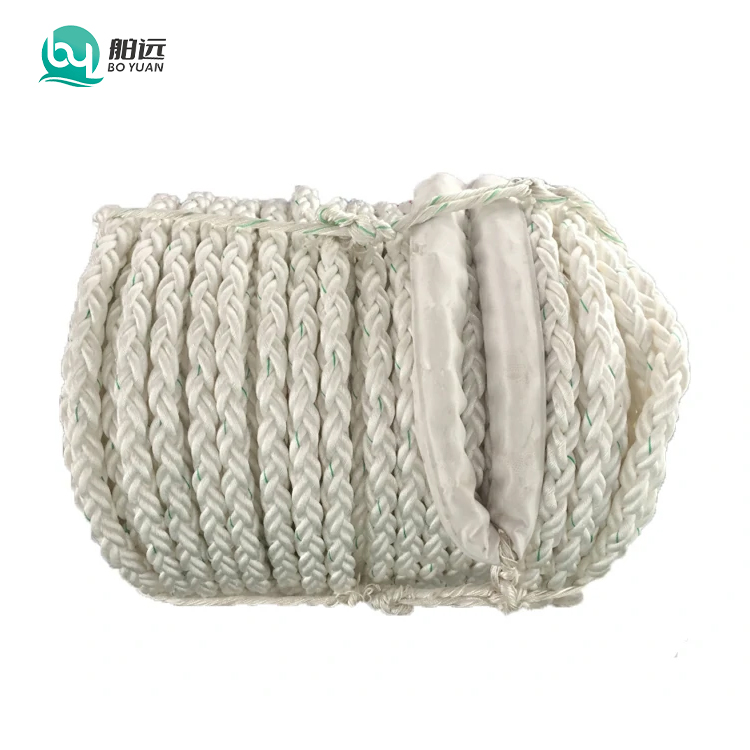
Construction: Double Braided Nylon Hawser
Material: High Tenacity Nylon 66
Diameter: 80MM -256MM
- Length: Custom Length
MBL: Up to Project Requirement
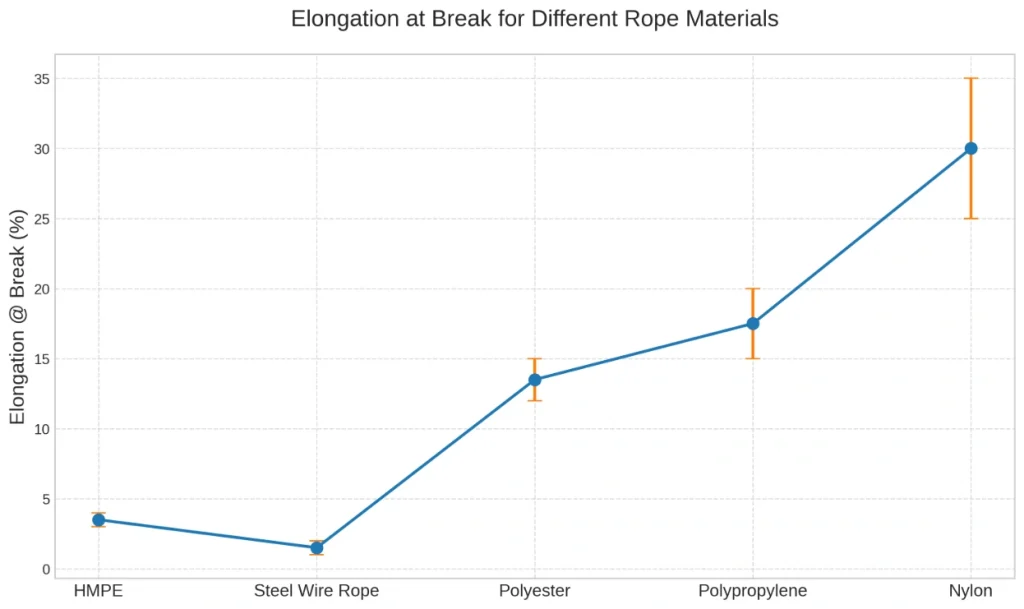
Elongation at Break: 35%-45%
Elongation at Working Load: 10%-15%
Wet Strength: 5% Lower Than Dry Strength
- Energy Absorption: Excellent
- Floating: No
Eye Configuration: Yes
Protective Sleeve:PU Sleeve / Leather / Polyester Cover
Chafe Chain Connection:Available
- Thimble: OPtional
- Compliance: OCIMF
SINGLE POINT ROPE DATA SHEET
View detailed data ↓
| DIAMETER | CIR | WEIGHT | Single Leg Type MBL | Grommet Type M B L | |||
|---|---|---|---|---|---|---|---|
| MM | INCH | INCH | KGS/100M | TON | KN | TON | KN |
| 80 | 3-5/32 | 10 | 406 | 132 | 1290 | 237 | 2320 |
| 88 | 3-7/16 | 11 | 506 | 167 | 1630 | 300 | 2940 |
| 96 | 3-13/16 | 12 | 585 | 191 | 1870 | 344 | 3370 |
| 104 | 4-1/8 | 13 | 699 | 222 | 2180 | 410 | 4020 |
| 112 | 4-7/16 | 14 | 798 | 263 | 2580 | 473 | 4640 |
| 120 | 4-3/4 | 15 | 914 | 298 | 2920 | 537 | 5260 |
| 128 | 5-1/16 | 16 | 1031 | 335 | 3280 | 603 | 5910 |
| 136 | 5-3/8 | 17 | 1164 | 382 | 3750 | 688 | 6740 |
| 144 | 5-11/16 | 18 | 1316 | 429 | 4210 | 773 | 7580 |
| 152 | 6 | 19 | 1490 | 478 | 4680 | 860 | 8430 |
| 160 | 6-5/16 | 20 | 1624 | 526 | 5160 | 947 | 9280 |
| 168 | 6-5/8 | 21 | 1785 | 574 | 5620 | 1033 | 10120 |
| 176 | 6-15/16 | 22 | 1986 | 641 | 6280 | 1153 | 11300 |
| 184 | 7-1/4 | 23 | 2165 | 693 | 6790 | 1248 | 12230 |
| 192 | 7-9/16 | 24 | 2351 | 741 | 7260 | 1334 | 13070 |
| 200 | 7-7/8 | 25 | 2554 | 811 | 7940 | 1459 | 14300 |
| 208 | 8-3/16 | 26 | 2756 | 884 | 8670 | 1592 | 15600 |
| 216 | 8-1/2 | 27 | 2957 | 952 | 9330 | 1714 | 16800 |
| 224 | 8-13/16 | 28 | 3161 | 1026 | 10050 | 1846 | 18090 |
| 232 | 9-1/8 | 29 | 3390 | 1094 | 10720 | 1969 | 19300 |
| 240 | 9-7/16 | 30 | 3628 | 1173 | 11500 | 2112 | 20700 |
| 248 | 9-3/4 | 31 | 3874 | 1257 | 12320 | 2262 | 22170 |
| 256 | 10-1/16 | 32 | 4128 | 1340 | 13130 | 2411 | 23630 |
Why Offshore Operators Choose Our Nylon SPM Hawsers
OCIMF MEG4
Designed with reference to OCIMF MEG4 recommendations, supporting safe offshore mooring practices for CALM buoy systems, oil terminals, and tanker operations.
ISO 10325
Manufactured in accordance with relevant international rope standards, ensuring consistent quality, reliable performance, and suitability for offshore mooring applications.
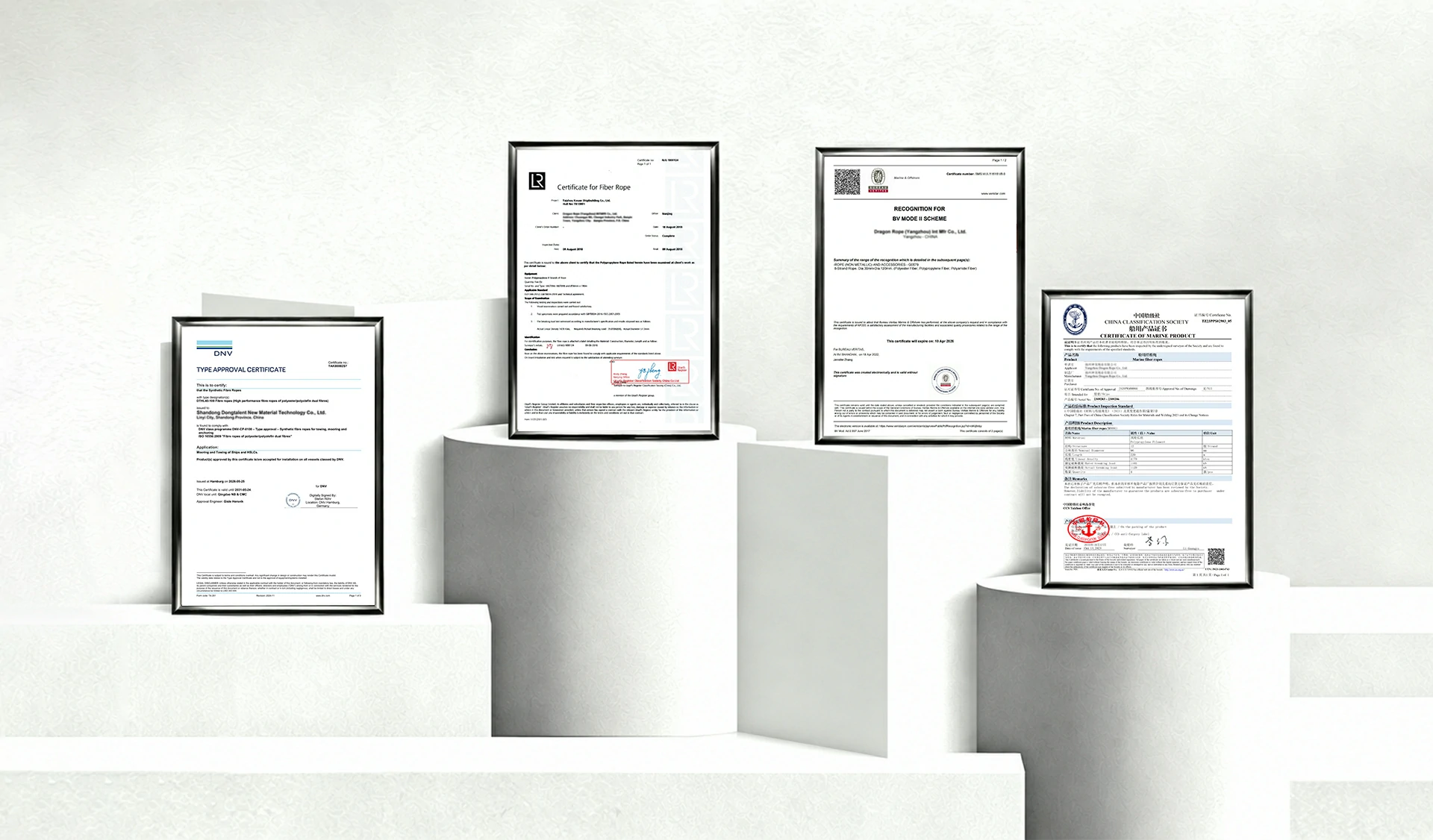
Third-Party Certification
Third-party inspection is available upon request by internationally recognized classification societies, including DNV, ABS, LR, BV, CCS, and NK, according to project requirements.
Factory Quality Assurance
Produced under an ISO 9001 certified quality management system, with strict raw material inspection, production control, load testing, and final quality verification.
CERTIFIED FOR MARINE USE
Qualified Premium Mooring Rope
Boyuan Rope is a professional mooring rope manufacturer. And our products meet third-party certifications.
Our certificates include: ISO 9001, BV, SGS, CCS, DNV, ABS, LR, etc.
Engineering & Lifecycle Support
1.Ensure Long-Term Offshore Performance
Routine inspection and proper maintenance are essential for maximizing the service life and operational safety of nylon SPM hawsers. Regular monitoring helps identify wear, prevent unexpected failures, and maintain reliable performance under demanding offshore conditions.
2.Before Every Mooring
Inspect the entire hawser before each operation. Check for cuts, broken yarns, abrasion, excessive wear, contamination, deformation, or damage to the eye splices and protective sleeves. Ensure all end fittings and connections are secure before use.
3. Eye Splice Inspection
The eye splice is one of the most highly stressed sections of an SPM hawser. Inspect for broken fibers, distortion, loosened strands, damaged thimbles, and wear on protective coverings. Replace worn protection as necessary.
4.Abrasion & Chafe Protection
Inspect external surfaces for abrasion caused by fairleads, chocks, chafe chains, or buoy connections. Protective sleeves and chafe protection should remain intact to minimize fiber damage and extend service life.
5.Storage & Handling
Store nylon hawsers in a clean, dry, and well-ventilated environment away from direct sunlight, chemicals, and heat sources. Avoid dragging the rope across rough surfaces and prevent twisting or excessive bending during handling.
6.Retirement Criteria
Remove the hawser from service if significant fiber damage, excessive abrasion, permanent deformation, internal core damage, or abnormal elongation is detected. Final retirement decisions should always follow project specifications and applicable offshore standards.
7.Service Life Management
Maintain detailed inspection records throughout the hawser’s operational life. Tracking service hours, inspection history, maintenance activities, and operating conditions helps optimize replacement planning and improve offshore safety.
Recommended Inspection Checklist
| Inspection Item | Frequency |
|---|---|
| Visual Surface Inspection | Before every mooring |
| Eye Splice Condition | Before every operation |
| Abrasion & Chafe Protection | Monthly |
| End Fittings & Connections | Every operation |
| Detailed Condition Assessment | Every 6–12 months |
| Complete Service Record Review | Annually |
Related Offshore Mooring Products

FAQ
1. What Is an SPM Hawser?
An SPM hawser (Single Point Mooring Hawser) is the primary mooring line connecting an oil tanker to a CALM or SALM buoy during offshore loading and unloading operations. It transfers mooring loads generated by wind, waves, and currents while allowing the vessel to safely weathervane around the buoy. Modern SPM hawsers are typically manufactured from double braided nylon because of their excellent strength, elasticity, and fatigue resistance.
2. Why Is Nylon the Preferred Material for SPM Hawsers?
Nylon is widely used for SPM hawsers because it offers outstanding energy absorption and excellent elasticity. Compared with HMPE or polyester, nylon can absorb dynamic shock loads generated by vessel motions, reducing peak loads on both the buoy and the tanker. This makes nylon the preferred material for most offshore CALM buoy applications.
3. What Is the Difference Between a CALM Buoy and an SPM Hawser?
A CALM buoy is the floating offshore structure that anchors the mooring system and supports oil transfer equipment. An SPM hawser is the flexible rope connecting the tanker to the buoy. While the buoy provides the mooring point, the hawser absorbs dynamic loads and keeps the vessel safely connected during loading operations.
4. Are Your SPM Hawsers Manufactured According to OCIMF Recommendations?
Yes. Our nylon SPM hawsers are designed with reference to OCIMF recommendations for offshore mooring systems. Construction, material selection, eye protection, testing, and quality control can all be customized to meet project specifications and third-party inspection requirements.
5. How Do I Choose the Correct Minimum Breaking Load (MBL)?
The required MBL depends on several factors, including tanker size, environmental conditions, water depth, operating location, and terminal design. Our engineering team can recommend an appropriate breaking load based on your project requirements and applicable offshore standards.
6. How Long Does an SPM Hawser Typically Last?
The service life of an SPM hawser depends on operating frequency, environmental conditions, maintenance practices, and loading cycles. With proper inspection, storage, and maintenance, a high-quality nylon hawser can provide many years of reliable offshore service. Regular inspections are essential to maximize service life and maintain operational safety.
7. What Is the Difference Between an SPM Hawser and a Standard Nylon Mooring Rope?
An SPM hawser is specifically engineered for offshore tanker mooring under continuous dynamic loading. Compared with ordinary nylon ropes, SPM hawsers generally feature double braided construction, reinforced eye splices, chafe protection, higher fatigue resistance, and project-specific testing to meet offshore operating requirements.
8. Can HMPE Replace Nylon in Single Point Mooring Applications?
HMPE ropes offer extremely high strength and low weight, but they have much lower elongation than nylon. Because SPM systems require significant energy absorption during vessel movement, nylon remains the preferred material for most conventional CALM buoy hawsers. HMPE may be suitable for selected offshore applications where low elongation is required, depending on the system design.
Offshore Mooring Knowledge Center
Explore the secure link in maritime world: mooring ropes.
Why Does an Offshore Mooring Hawser Drawing Show Two Different Lengths?
The question about o