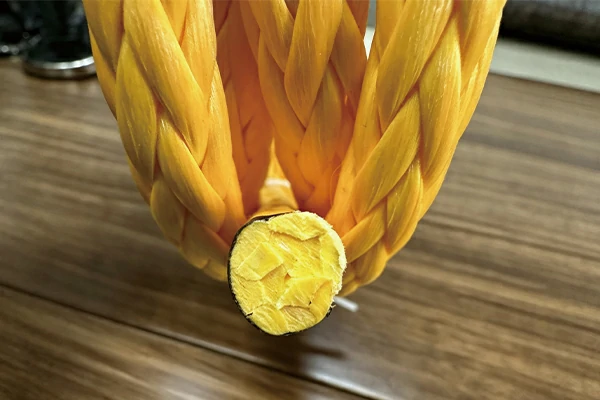
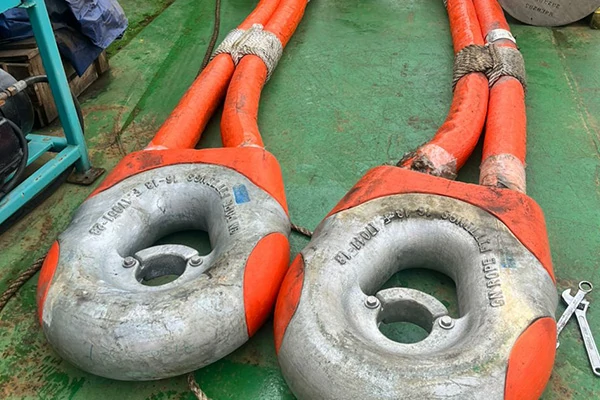
The discrepancy between nominal fiber tenacity and actual rope performance is one of the most complex challenges in offshore mooring manufacturing. When building large-diameter HMPE (High Modulus Polyethylene) ropes, you are not just buying strength; you are buying the translation efficiency of millions of filaments working in unison over decades.
Here is an expert-level breakdown of why fibers with identical spec-sheet tenacities perform differently in the field.
1. Fiber Properties with the Greatest Impact on Final Rope Performance
While tenacity is the baseline requirement, the ultimate performance of a large mooring rope is governed by how well the fibers share the load and resist environmental and mechanical degradation. The most critical properties include:
Consistency (Coefficient of Variation – CV%): The variance in strength and elongation across thousands of meters of yarn. A rope is only as strong as its load-sharing capability.
Elongation at Break (EAB) and Modulus: Filaments must stretch uniformly. If some filaments are stiffer (higher modulus) than others, they will take the load prematurely and snap, leading to a cascading failure of the rope.
Spin Finish (Coating): The proprietary chemical coating applied during fiber extrusion. This governs internal friction, heat dissipation, and abrasion resistance.
Molecular Weight (MW) and Intrinsic Viscosity (IV): Higher molecular weight polymer bases generally translate to better creep and fatigue resistance, even if the absolute breaking tenacity is identical to a lower MW polymer that has been heavily drawn.
2. Why Identical Tenacity Produces Different Rope Behaviors
Tenacity (e.g., 38–40 cN/dtex) is measured on a single yarn under ideal, static laboratory conditions. Rope performance is dynamic and structural.
MBL (Minimum Breaking Load): Two fibers with 40 cN/dtex will yield different rope MBLs if their CV% of elongation differs. In a 100mm diameter rope, if the inner fibers stretch differently than the outer fibers, the translation efficiency drops. Fiber A might yield an 80% strength translation, while Fiber B yields only 65%.
Service Life: This is dictated by the polymer’s resistance to thermo-oxidative degradation and UV exposure. The quality of the antioxidants mixed into the gel-spinning solvent and the uniformity of the fiber’s crystalline structure determine how long the fiber maintains its baseline properties.
Creep Performance: Creep is heavily dependent on the polymer’s molecular weight and the drawing ratio used during manufacturing. A manufacturer can achieve 40 cN/dtex by aggressively over-drawing a cheaper, lower-molecular-weight polymer. This highly drawn fiber will have excellent initial strength but catastrophic long-term creep because the molecular chains will easily slide past one another under sustained offshore tension.
Fatigue Resistance (Tension-Tension & CBOS): Bend-over-sheave (CBOS) and cyclic loading cause internal filament-on-filament abrasion. Fiber with an inferior or unevenly applied spin finish will generate excessive internal friction and heat, causing the fiber to fibrillate (split longitudinally) and fail prematurely.
Abrasion Resistance: External abrasion resistance is tied directly to the fiber’s surface crystallinity and the robustness of the spin finish. Some fibers are prone to surface micro-cracking during the gel-spinning process, which creates microscopic abrasive edges that accelerate wear.
3. Hidden Quality Indicators (Hardest to Detect, Highest Impact)
These are the metrics rarely listed on a standard Technical Data Sheet (TDS) but separate premium fibers from commodities:
Oil Pick-Up (OPU) Consistency: The exact percentage of spin finish on the fiber. If the OPU fluctuates along the length of the yarn, your rope will have “hot spots” of high friction, leading to localized melting or fatigue failure.
Fibrillation Index: The tendency of the primary filaments to splinter into micro-fibrils under transverse pressure. High fibrillation drastically reduces fatigue life but requires scanning electron microscopy (SEM) or specialized yarn-on-yarn abrasion testing to detect.
Molecular Weight Distribution (Polydispersity): Identifiable via Gel Permeation Chromatography (GPC). A narrow molecular weight distribution means all polymer chains are roughly the same length, leading to highly predictable creep and fatigue behaviors. A wide distribution means a mix of short and long chains, leading to unpredictable failure mechanics.
Residual Solvent Content: Trace amounts of the solvent (e.g., mineral oil or decalin) left over from the gel-spinning process. High residual solvent acts as a plasticizer, artificially softening the fiber and severely accelerating creep.
4. Comparison Between International Leading Brands and Chinese UHMWPE Manufacturers
Note: The term “average level of Chinese manufacturers” below refers to small & medium-sized general manufacturers. A small number of top-tier high-end Chinese fiber makers have narrowed the performance gap significantly; they only lag behind international giants in long-term service data and scenario-specific patents.
| Feature | International Leading Brands (Dyneema by Avient, Spectra by Honeywell) | Average Level of General Chinese Manufacturers | Top-Tier High-End Chinese Fiber Manufacturers (Jiujiu, Nanshan Zhishang, etc.) | Practical Impacts on Rope Makers & Overseas Projects |
|---|---|---|---|---|
| Consistency (CV%) | Extremely low batch-to-batch tolerance. CV value stably ≤3%. Closed-loop precision temperature control for spinning & drawing ensures nearly identical performance across batches. | Large performance variance. CV value generally ranges 6%–12%. Breaking strength & modulus deviate notably between different production lots. | CV value steadily controlled ≤4%, close to mid-tier international products. | 1. Stable imported fiber enables accurate MBL (Minimum Breaking Load) calculation, allowing lower safety factors and material cost savings. 2. General domestic fiber requires extra safety redundancy in design, increasing rope weight and material costs. 3. High-end domestic fiber qualifies for mid-range overseas projects, yet deep-sea critical projects demand extra batch inspection reports. |
| Coating & Surface Treatment Technology | Highly proprietary patented coatings customized for niche applications (marine anti-salt-fouling coatings, ballistic low-friction coatings). Optimized for long-term saltwater immersion and repeated bending to deliver superior inter-yarn abrasion resistance and low internal heat buildup. | Generic off-the-shelf surface finishing only, without customized modification for harsh marine environments. Poor strand abrasion resistance and severe internal heat generation under cyclic loads. | Self-developed plasma surface modification & marine-specific coatings, yet far fewer patented formulas for segmented application scenarios vs. international brands. | Mooring ropes made from imported fiber deliver drastically longer fatigue life and better wear resistance than ropes from general domestic fiber. High-end domestic alternatives match mid-grade imports, but gaps remain under extreme long-term offshore service conditions. |
| Polymer Raw Material Quality & Creep-Fatigue Performance | Ultra-high intrinsic viscosity resin with molecular weight 2.4–2.6 million and narrow molecular weight distribution. Slow creep under constant long-term load, high residual strength after cyclic fatigue. | Mostly low-molecular-weight resin (1.8–2.1 million). Manufacturers compensate for raw material defects via extreme stretching. Static tenacity passes lab tests, yet faster creep and shorter fatigue lifespan in offshore environments. | High-uniformity virgin resin adopted; creep & fatigue performance catch up with mid-tier imports, with marginal gaps only under ultra-long continuous service. | General domestic fiber performs well in static lab tests but deforms prematurely when deployed for long-term offshore mooring (shipping, offshore wind). High-risk overseas project owners seldom accept static test data alone for qualification. |
| Historical Database & Traceability | 30+ years of field service data accumulated across global sea zones. Complete archives covering creep, aging and failure curves, with full traceable records recognized by major classification societies. | Limited long-term offshore field data due to shorter industrialization timeline. Performance conclusions rely mostly on lab accelerated aging simulations, lacking proven track records of overseas projects. | Around 10 years of nearshore domestic project data accumulated, but insufficient long-term measurement records from European/American deep-sea & offshore platforms, plus limited patent & project track records. | European & American shipowners, offshore wind developers and marine underwriters prioritize international brands in tenders. All domestic fiber (including high-end grades) must pass extensive third-party long-term aging tests to qualify for premium overseas projects, leading to higher audit barriers. |
5. Top 10 Technical Indicators for Procurement
If you must constrain your evaluation to 10 indicators, prioritize these to ensure high translation efficiency and offshore reliability:
Tenacity (cN/dtex): The baseline strength requirement.
Tenacity CV%: Must be as low as possible. High variance destroys rope MBL translation.
Elongation at Break (EAB): Crucial for matching fiber behavior within the rope structure.
EAB CV%: Even more critical than Tenacity CV%. Uneven stretch causes catastrophic sequential filament failure.
Creep Rate (% at specific Load/Temperature): Essential for permanent offshore mooring (e.g., 20% MBL at 20°C over 10 years).
Yarn-on-Yarn Abrasion (Cycles to failure): The best proxy for internal rope friction and the quality of the spin finish.
Oil Pick-Up (OPU %): Ensures the manufacturer is applying sufficient and consistent protective coating.
Intrinsic Viscosity (dl/g): A direct indicator of the polymer’s molecular weight. Higher IV generally equates to better long-term durability.
Linear Density (dtex/denier) & dpf (denier per filament): Finer filaments (lower dpf) generally offer higher strength and flexibility, but slightly lower external abrasion resistance.
Thermal Shrinkage (%): Indicates internal stress from the drawing process. High shrinkage can lead to unstable rope structures when exposed to elevated temperatures.
Are you currently experiencing a specific mode of failure—such as premature core fusion, uneven load sharing, or excessive creep—in your recent offshore deployments that prompted this supply chain review?